From Automation to Intelligence: How AI Agents Are Redefining Enterprise Operations

Organizations across industries are accelerating digital transformation to remain competitive in a rapidly evolving business landscape. Artificial intelligence has emerged as a key enabler, helping companies streamline operations, enhance decision-making and improve customer experiences. Among the most impactful advancements is the rise of AI agents, which are redefining how work is executed across business functions.
AI agents are not just tools for automation. They represent a shift toward intelligent systems capable of perceiving, reasoning and acting autonomously. As businesses seek greater efficiency and agility, these agents are becoming essential components of modern enterprise operations. Their ability to operate with minimal human intervention makes them particularly valuable in complex, data-driven environments.
Overview of AI agents
AI agents are software entities that use artificial intelligence to perform tasks autonomously or semi-autonomously. They can interpret data, make decisions and execute actions based on predefined goals and contextual understanding. Unlike traditional automation tools, AI agents are adaptive and can learn from interactions and outcomes.
Organizations are increasingly exploring AI agents to enhance operational capabilities. These agents leverage technologies such as machine learning, natural language processing and advanced analytics to perform complex tasks across various domains.
AI agents typically consist of several core components, including perception, reasoning, decision-making and action. They gather data from multiple sources, analyze it to generate insights and take appropriate actions to achieve specific objectives. This end-to-end capability enables them to operate across entire workflows rather than isolated tasks.
In enterprise environments, AI agents are often integrated with existing systems such as enterprise resource planning, customer relationship management and supply chain platforms. This integration allows them to access real-time data and provide intelligent recommendations that improve operational efficiency.
Benefits of AI agents
AI agents deliver significant value by enhancing efficiency, reducing costs and improving decision-making across organizations.
1. Increased operational efficiency
AI agents automate repetitive and time-consuming tasks, allowing employees to focus on higher-value activities. By handling routine processes such as data entry, report generation and workflow management, they reduce manual effort and improve productivity.
This leads to faster execution of business processes and improved overall efficiency.
2. Enhanced decision-making
AI agents analyze large volumes of data to generate actionable insights. They can identify patterns, trends and anomalies that may not be apparent to human analysts.
This capability enables organizations to make more informed decisions based on data-driven insights rather than intuition.
3. Improved accuracy and consistency
Human errors can lead to inefficiencies and increased costs. AI agents minimize errors by following consistent processes and applying standardized rules.
This ensures higher accuracy in tasks such as financial reporting, inventory management and customer service operations.
4. Greater scalability
AI agents can handle large volumes of work without a proportional increase in resources. As business demands grow, organizations can scale operations efficiently by deploying additional agents.
This scalability is particularly valuable in industries with fluctuating demand and high transaction volumes.
5. Enhanced customer experience
AI agents enable faster response times and personalized interactions. They can handle customer inquiries, provide recommendations and resolve issues in real time.
This improves customer satisfaction and strengthens brand loyalty.
Use cases of AI agents
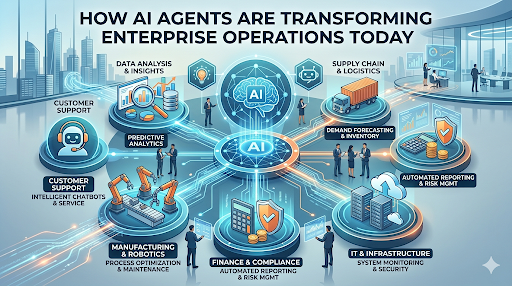
AI agents are being deployed across a wide range of business functions, delivering measurable improvements in performance and efficiency.
1. Customer service automation
AI agents are widely used in customer service to handle inquiries, process requests and provide support. They can interact with customers through chatbots, virtual assistants and voice interfaces. These agents improve response times, ensure consistent service quality and reduce the workload on human agents.
2. Finance and accounting operations
In finance, AI agents automate tasks such as invoice processing, expense management and financial reporting. They can analyze financial data to identify discrepancies and ensure compliance with regulatory requirements. This enhances accuracy and reduces the time required for financial processes.
3. Supply chain and logistics management
AI agents optimize supply chain operations by analyzing demand patterns, managing inventory and coordinating logistics activities. They can predict disruptions and recommend alternative strategies to maintain continuity. This improves efficiency and reduces operational risks.
4. Human resources management
AI agents streamline HR processes such as recruitment, onboarding and employee engagement. They can screen resumes, schedule interviews and provide insights into workforce trends. This enables HR teams to focus on strategic initiatives rather than administrative tasks.
5. IT operations and cybersecurity
AI agents play a critical role in IT operations by monitoring systems, detecting anomalies and responding to security threats. They can identify vulnerabilities and take corrective actions in real time. This enhances system reliability and strengthens cybersecurity defenses.
Organizations looking to deploy these capabilities often rely on AI implementation services to ensure successful adoption and integration across business functions.
Why choose The Hackett Group® for implementing AI agents
Implementing AI agents requires a combination of strategic vision, technical expertise and deep functional knowledge. The Hackett Group® is recognized for its data-driven approach and extensive benchmarking capabilities, which help organizations achieve world-class performance.
1. Proven expertise in digital transformation
The Hackett Group® has a strong track record of helping organizations transform their operations through advanced technologies. Its research-driven insights enable businesses to identify opportunities and implement best practices. This ensures that AI agent initiatives are aligned with broader business objectives.
2. Comprehensive implementation approach
From strategy development to execution, The Hackett Group® provides end-to-end support for AI adoption. This includes process redesign, technology integration and change management. Such a holistic approach ensures seamless implementation and long-term success.
3. Advanced tools and platforms
The Hackett Group® leverages advanced tools to accelerate the adoption of AI agents. The Hackett AI XPLR™ platform enables organizations to explore use cases, test scenarios and deploy solutions effectively. This helps organizations maximize the value of their AI investments.
4. Focus on measurable outcomes
A key strength of The Hackett Group® is its emphasis on delivering tangible business results. The firm focuses on metrics such as cost reduction, efficiency improvement and service quality enhancement. This ensures that AI agent implementations drive real value rather than just technological innovation.
Conclusion
AI agents are transforming the way organizations operate by enabling intelligent automation and data-driven decision-making. Their ability to perform complex tasks autonomously makes them a powerful tool for improving efficiency, scalability and customer experience.
As businesses continue to embrace digital transformation, AI agents will play an increasingly important role in shaping the future of enterprise operations. Organizations that adopt these technologies strategically will be better positioned to navigate challenges, seize opportunities and achieve sustainable growth.
By leveraging the right expertise, tools and methodologies, companies can successfully implement AI agents and unlock their full potential in driving business success.